
10 Locations of Budget-Friendly Offices to Rent in London

A small passenger boat for tourists, with its red-garbed pilot standing at the stern, is guided down one of the calm waterways in the Canary Wharf area of London. Skyscrapers of different sizes and designs rise from the banks, and their windows shimmer under a blue, daytime sky mottled with some greyish-white clouds. Canary Wharf and many other London areas in its vicinity are more budget-friendly when seeking out offices to rent compared to more central London locations. Image at LondonOfficeSpace.com.

At a Glance: Comparison of Budget-Friendly Offices to Rent in London

London Area What You Get Why It’s Affordable
Hackney Creative hub with serviced offices & meeting rooms Lower rent than Shoreditch, rising value
Wood Green / Haringey Private offices with bike storage & concierge Suburban price, fast central access
South London Managed workspace with flexible lease terms Lower competition vs West End
Cheapside Serviced office space with communal areas Central postcode, competitive rates
Paddington Private offices from £399/month near Oxford Street Excellent transport + modern amenities
Aldgate Flexible offices with breakout areas Prime location at budget prices
Moorgate Fully furnished offices with meeting rooms Cost-effective compared to nearby districts
Holborn Flexible office spaces with included services West End proximity without premium cost
Shoreditch Affordable coworking + small offices Pay only for the space you use
Victoria Serviced offices with maximum productivity features Central location at competitive rates

Finding affordable office space in London can feel like a challenge, but there are still plenty of budget-friendly offices to rent in London that don’t compromise on quality. Whether you’re a startup, freelancer, or small team, these options provide the right mix of accessibility, modern facilities, and competitive rates.

1. Hackney – Affordable Creative Workspaces

Hackney has become a go-to destination for creative and digital companies seeking cost-effective office solutions. Many serviced offices here are fully furnished, equipped with meeting rooms, and often include breakout areas that encourage collaboration. With excellent transport links and a lively cultural scene, Hackney offers real value compared to pricier neighbourhoods like Shoreditch.
View Hackney office space

2. Wood Green / Haringey – Suburban Value and Coworking Spaces with City Access

The Wood Green area within the borough of Haringey delivers some of the best-priced serviced office space in North London. You’ll find private offices, coworking desks, and flexible lease terms, all with reliable high-speed internet and professional facilities. Larger spaces such as Parma House also provide workshop and industrial units to accommodate small and medium-sized companies. Just a short walk from transport hubs, it’s easy to rent office space here and reach central London quickly.
Explore Wood Green offices

Continue reading “10 Locations of Budget-Friendly Offices to Rent in London”

Cost of Office Space in London – Startup Survival Guide

A daytime view from the lush and expansive green surrounds of Greenwich Park towards the skyline of London’s business district. The Greenwich area is to the south-east of central London, and the cost of office space there is much more affordable than the city’s core, ideal for startup survival if they are cash-strapped. Image at LondonOfficeSpace.com.

Cost to Rent Office Space in London: At-A-Glance

Aspect Central London Outskirts/Outer Boroughs
Cost High rents and high business rates. £70-£88 / sqft for Grade A office space in The City. Lower rents and overheads. Averages of £30 / sqft for North London outskirts locations.
Startup survival Prone to burn through capital Extended runway boosts resilience
Brand signal Conveys prestige and trustworthiness Matches modern and agile brand narratives
Ideal sectors Finance/Insurance/Legal startups Tech and creative 

For startups in London, choosing an office location isn’t just a logistical decision: it’s a strategic move with real implications for cost control, client perception, and long-term survival. The choice between setting up a serviced office space in central London postcodes or in the outskirts is often one of the most important financial decisions a company will face at its earliest stage.

To help with that decision, in this article, we offer a data-driven analysis of the pros and cons of each option to rent office space, comparing costs, survival rates, and brand impact from central London and outer borough offices.

Continue reading “Cost of Office Space in London – Startup Survival Guide”

Average Office Space Requirements for Different Industries: A Data-Driven Analysis

A close-up view of the top couple of floors of an office building with a red facade. The many rectangular windows have a matte greyish-blue shine, and a strip of blue, daytime sky is visible above the top of the building. Image at LondonOfficeSpace.com.

Key findings – How much office space do I need?

  1. “Hybrid layouts can reduce space needs by 10–50%, translating into cost savings of up to £8,500 per employee/year.”
  2. Office density directly impacts costs: There’s a 3–4× difference in space and cost allocation between call centres and finance firms.”
  3. In 2024, the average London office footprint was 5,622 sqft — but sector demand varies widely, with financial firms averaging 10,262 sqft and creative agencies managing with as little as 500 sqft.”
  4. “77% of sub-70 desk lettings in West London were on flexible terms in 2024 — and flex leases below 5,000 sqft are more cost-effective than conventional leases under 5 years.”

Office requirements aren’t just about aesthetics or amenities; square footage is also a key factor that can help businesses operate efficiently, especially in demand-driven real estate markets like London. 

Office Space Needs Will Vary by Industry/Sector

Different industries work in fundamentally different ways, and their square footage needs reflect that. Industry-specific workflows, employee density, tech infrastructure, collaboration style, and client interaction models all play a role in shaping how much office space is required. 

In this article, we’ll look at the unique office space requirements of different sectors and at the factors you need to keep in mind to make informed leasing decisions that align your workspace strategy with your operational needs.

Continue reading “Average Office Space Requirements for Different Industries: A Data-Driven Analysis”

What is an Office Brokerage—and Why Use One to Find Office Space in London?

A golden hour view of the London skyline featuring The Shard and Walkie Talkie buildings, highlighting the prime office space locations for businesses using a brokerage in 2025. Image at LondonOfficeSpace.com.

In an age where office space search platforms list hundreds of commercial properties at the click of a button, it’s easy to assume that office brokers are redundant.

But in today’s complex London office market—where prime rents are rising, and office space availability is tightening (especially for premium, new office space in high-demand locations)—the question isn’t why brokers still exist, but rather, why use an office space brokerage in 2025?

Yes, you can now hop on any number of search platforms and, in seconds, be armed with a comprehensive overview of the London office market and rental rates, but there is no algorithm yet that replaces the value of expert lease negotiations, office broker relations, deep market knowledge, and real-world cost-cutting strategies.

Real-World Experience With a London Office Broker

Simon Lee, CEO of app development firm Glance, recounts his experience of using a brokerage: “We compared 30 off-market units and signed a five-year lease at 18% below asking,” he shared. “Our broker wrapped rent, cleaning, and business rates into one tidy monthly invoice.”

That efficiency allowed Glance to transition from a 10-desk co-working pod to a 35-seat office in Shoreditch without losing control of costs or flexibility.

Continue reading “What is an Office Brokerage—and Why Use One to Find Office Space in London?”

What is BREEAM Certification? Sustainable Office Design in London

A low-angle daytime view up at three towering skyscrapers in the London business district. The buildings are modern with glass facades shining with a turquoise hue under a cloudy sky. Modern London office buildings are leading the way when it comes to sustainable office design, many attaining Excellent or Outstanding BREEAM ratings. Image at LondonOfficeSpace.com.

In the London commercial real estate market, sustainable office design is no longer a trend, but a defining factor. With growing pressure from regulatory requirements, corporate ESG commitments, and changing tenant expectations, demand for green office spaces has never been higher. As a result, businesses and landlords are rethinking their approach to office space.

One of the key ways they’re doing this is through BREEAM certification, which stands for Building Research Establishment Environmental Assessment Method. Originating in the UK, BREEAM is a guideline for sustainable building design that is now accepted as a gold standard the world over. But what exactly does BREEAM involve, and why does it matter for landlords and occupiers in the London office market? Let’s take a look at how London offices are going green through this accredited standard.

The Green Shift in London’s Office Market

The demand for sustainable office spaces in London has surged in recent years, driven by stronger enforcement of corporate responsibility schemes and stricter government regulations, such as Net Zero Commitments, ESG (Environmental, Social, and Governance) Requirements, and Minimum Energy Efficiency Standards (MEES).

This has caused a shift in how commercial real estate is valued. For example, Grade A offices are now exclusively comprised of those that meet green criteria. As a result, landlords are prioritising green features that improve energy efficiency, reduce waste, and create healthier working environments.

Continue reading “What is BREEAM Certification? Sustainable Office Design in London”

London Commercial Space Trends

A daytime view from the median strip down a central London two-way street towards the 30 St Mary Axe building, popularly referred to as The Gherkin, peeking above other buildings in the distance. Other skyscrapers rise alongside the street, which also contains moderate traffic going both directions, with two of London’s iconic red double-decker buses heading away from the viewer and two coming towards the viewer. Image at LondonOfficeSpace.com.

The London commercial market has entered 2025 on an upswing. After a period of uncertainty due to changing remote and hybrid work arrangements, occupiers are displaying renewed confidence, driving demand for both premium office spaces and flexible workspace options. 

If you’re planning to set up an office in London, or want to upgrade your office space within the city, you’ll want to know how the capital’s office market is evolving this year. In this article, you’ll find an overview of the key trends across the London commercial real estate landscape.

Snapshot of the London Office Market

Take-up volume and rental rates on the rise

2025 started on a positive note for the London office market, after registering the second highest take-up volume of the last five years and a strong upward trajectory in rental growth rates for Grade A offices.

Renewed interest in large office units

So far, nearly 90% of all transactions involved offices under 25,000 square feet. At the same time, leases for large offices of 75,000 square feet and above are back on the table and at their highest levels since 2019. Appetite for larger office floor plates is mostly driven by lower interest rates that are increasing liquidity in the budgets of occupiers.

London leading in data centre space

Market analysts are drawing attention to data centre space, as new supply is expected to reach all-time high in 2025, and London is emerging as one of the main global hubs for data centre space.

Continue reading “London Commercial Space Trends”

The Most Haunted Places in London, England: Office Buildings Edition

A nighttime view of a woman standing at the end of a bridge looking towards Big Ben and the Gothic spires of Westminster Hall and the House of Lords across the river. The sky is dappled grey and sheets of rain are pouring down. The primary light sources are Big Ben’s lit clock face and the antiquated light post with three lantern-like lights lit to the woman’s left. Image at LondonOfficeSpace.com.

London isn’t only a city steeped in history; many of its buildings are surrounded by an aura of mystery and dark forces. In fact, even some of the city’s modern office buildings are said to be haunted places. If you’re an employee working late in certain London offices, you might have more than your workload to worry about! Let’s take a look at some of London’s most haunted office buildings, where ghosts might also be coming to clock in.

1. Fenchurch Street – EC3

Offices in Fenchurch Street range from listed buildings to modern landmark towers that will surely impress clients and visitors. But some people might not realise that office buildings in Fenchurch Street are just half a mile away from the Tower of London, one of the city’s most infamous haunted spots. 

Continue reading “The Most Haunted Places in London, England: Office Buildings Edition”

London Office Market Report 2024

A daytime view of the top half of Big Ben clock tower in London framed by a brilliant blue and white cloud-strewn sky. Image at LondonOfficeSpace.com.

The London Office Market in 2024 – At a Glance

The central London office market continues to shift in line with previous years’ trends, such as generalised downsizing due to hybrid work arrangements, a flight to quality, and a limited development pipeline. Although the first quarter of 2024 showed evidence of a slowdown in activity, this slow start of the year isn’t concerning considering that the market ended 2023 on a five-year high.

Here are some key indicators that summarise the status of the London office market in 2024:

Total take-up levels were 2.47 million square feet in Q1, vs. 2.1 million square feet during the same period in 2023.

Vacancy rates city-wide have increased to 9.5% in Q1 2024, vs. 8.9% in 2023.

– Lastly, the amount of office space under construction also remains stable, with 15.86 million square feet in 2024 vs. 16.75 million in 2023.

Continue reading “London Office Market Report 2024”

New Developments in London Office Space: Central

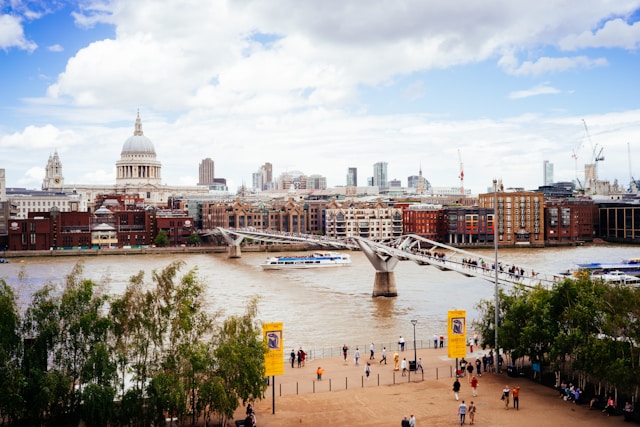
A daytime view down the bank of the River Thames towards the crowded Millennium Bridge and the central London cityscape beyond. Image at LondonOfficeSpace.com.

Knowing the status of the central London office development pipeline is essential for businesses looking to stay ahead in one of the world’s most dynamic real estate markets. By understanding the current trends and future developments, businesses can make informed decisions about their office space needs and take advantage of emerging opportunities.

In this article, we take a look into upcoming developments and what they mean for the Central London office leasing market. 

Central London offices development pipeline

According to data from the latest London Office Crane Survey, which looks in detail at the city’s development pipeline, the main highlight during the second half of 2023 was the record volume of square feet under construction. As of Q4 2023, there were more than 5 million square feet of new builds underway in central London, the highest amount since 2005. That figure represents a 16% increase over a six-month period. The report also identifies increases in project size, going from averages of 88,000 square feet in early 2023 to 119,000 square feet of properties in late 2023.

Continue reading “New Developments in London Office Space: Central”

Benefits of Modular Office Furniture for Flexible Workspaces

A man works alone at a modular desk in a flexible workspace. Image at LondonOfficeSpace.com.

Flexible work schedules and flexible workspace are now the norm in many office-based businesses. Modular office furniture is the perfect complement to work arrangements where versatility and flexibility are a must. In this article, we look at the main advantages of choosing modular furniture for your office space.

What’s modular office furniture?

This concept refers to furniture items that can be used either as standalone pieces or combined to create different configurations. Examples of modular office furniture include modular desk spaces that can be grouped together in numbers or separated as needed, storage units or filing cabinets that can be stacked and easily moved about, and seating options that can be arranged to accommodate different occupancy levels or activity types. 

Unlike traditional office furniture, which is typically designed for specific uses, modular furniture is made to be versatile and adaptable. This flexibility makes it ideal for modern workspaces, where the ability to reconfigure layouts to suit changing needs of employees and the business is increasingly needed. Let’s look at other benefits that this furniture type can offer.

Continue reading “Benefits of Modular Office Furniture for Flexible Workspaces”