London Commercial Space Trends

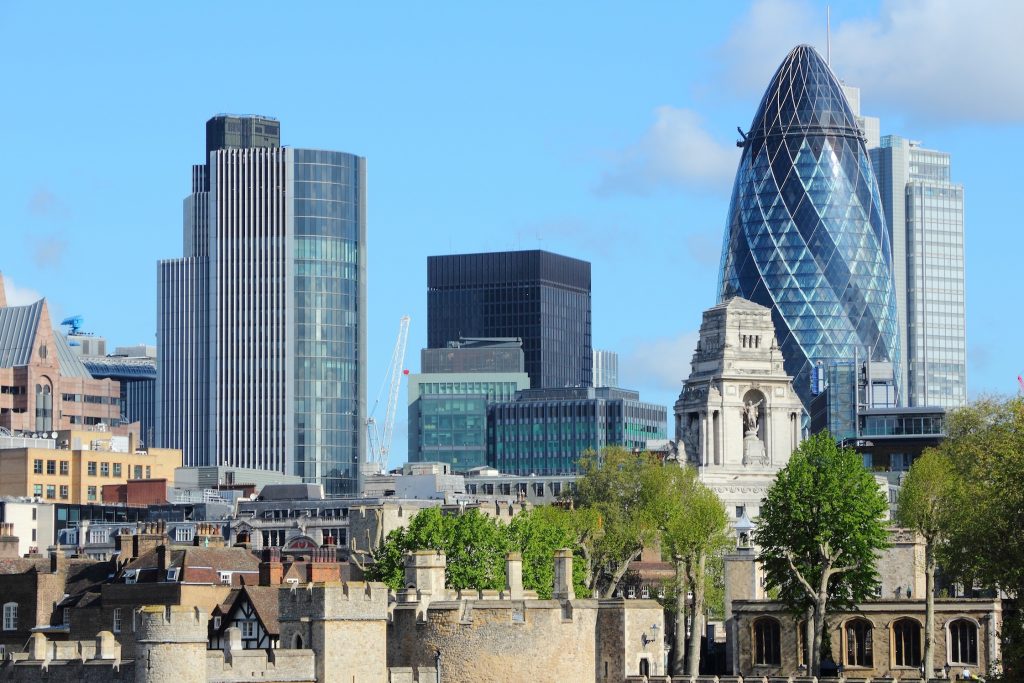
A daytime view from the median strip down a central London two-way street towards the 30 St Mary Axe building, popularly referred to as The Gherkin, peeking above other buildings in the distance. Other skyscrapers rise alongside the street, which also contains moderate traffic going both directions, with two of London’s iconic red double-decker buses heading away from the viewer and two coming towards the viewer. Image at LondonOfficeSpace.com.

The London commercial market has entered 2025 on an upswing. After a period of uncertainty due to changing remote and hybrid work arrangements, occupiers are displaying renewed confidence, driving demand for both premium office spaces and flexible workspace options. 

If you’re planning to set up an office in London, or want to upgrade your office space within the city, you’ll want to know how the capital’s office market is evolving this year. In this article, you’ll find an overview of the key trends across the London commercial real estate landscape.

Snapshot of the London Office Market

Take-up volume and rental rates on the rise

2025 started on a positive note for the London office market, after registering the second highest take-up volume of the last five years and a strong upward trajectory in rental growth rates for Grade A offices.

Renewed interest in large office units

So far, nearly 90% of all transactions involved offices under 25,000 square feet. At the same time, leases for large offices of 75,000 square feet and above are back on the table and at their highest levels since 2019. Appetite for larger office floor plates is mostly driven by lower interest rates that are increasing liquidity in the budgets of occupiers.

London leading in data centre space

Market analysts are drawing attention to data centre space, as new supply is expected to reach all-time high in 2025, and London is emerging as one of the main global hubs for data centre space.
Continue reading “London Commercial Space Trends”

London’s Office Buildings Making It Big In Hollywood


For decades, London has been a top location for the film industry. Hundreds of movies and TV series have been set in London, whether in famous studios like Pinewood, Ealing, Leavesden, or Shepperton, or in the city’s streets and iconic buildings. More recently, some of London’s most representative office buildings have drawn the attention of filmmakers, since their varied architectural styles lend themselves to becoming the setting of everything from comedy to action films. Let’s take a look at the London office buildings that are making it big in Hollywood.

1. The Gherkin

One of London’s most iconic buildings, the Gherkin has received multiple awards due to its unique design and futuristic architecture. This 41-storey high office building was completed in 2003 and its tenants include Regus, Standard Life, JDA, ION Trading, and Kirkland and Ellis (1).

The Gherkin has appeared in several Hollywood blockbusters, including:

– Match Point (2005)
– Basic Instinct 2 (2006)
– A Good Year (2006)
– Harry Potter and the Half Blood Prince (2009)
– Thor: The Dark World (2013)

Continue reading “London’s Office Buildings Making It Big In Hollywood”

Serviced Office Space to Become More Popular in 2015

As one of the world’s leading commercial and economic powerhouses, the city of London attracts thousands of entrepreneurs and investors every year. According to a recent report, in the Tech City alone more than 15,000 new businesses were established during 2013, and this has prompted a surge in the demand for adequate office premises in this London neighbourhood. There are many other areas of London that are also experiencing a growing shortage of office floor space, mainly those in the northern city fringe area and in central London, where new developments are severely limited.

Continue reading “Serviced Office Space to Become More Popular in 2015”

London Office Space 2015: Expected Growth Areas

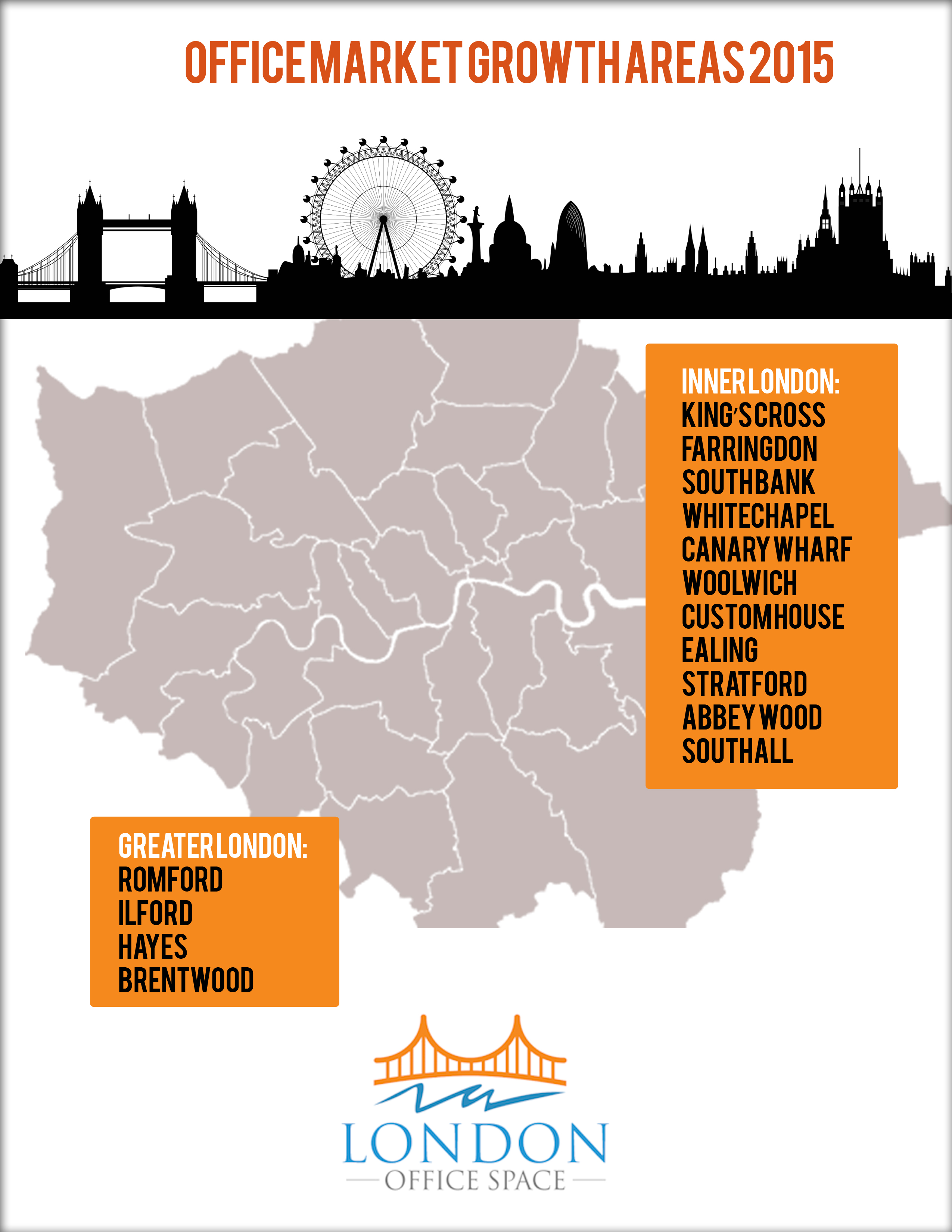
Expected London Office Market Growth Areas in 2015

Last year was undoubtedly a positive year for landlords and tenants in the London commercial property market. Towards the end of the year, real estate experts released their forecasts for 2015. The predictions are full of positive and encouraging figures and point at a healthy market where growth is set to dominate. Take a look at some of the most important trends regarding the key growth areas for the commercial property market in London during 2015.

2015 Outlook: What landlords and investors need to know

According to market analysts at Schroders, during 2015 a number of factors will result in a very attractive property market for landlords and investors interested in London properties. A recovering economy, decreasing unemployment rates, and a limited development pipeline are set to drive demand for existing floor space and to push commercial property values even further. For investors, this means that property yields can reach double digit levels, although all the predictions point at the commercial rental market as the best performing over the next 12 months. According to data from the Investment Property Forum Consensus Forecast, total returns could be as high as 15 per cent during 2015. Rising interest rates are not expected to become a possibility until 2016.

London office space market growth areas in 2015 infographic

Continue reading “London Office Space 2015: Expected Growth Areas”

Housing for London Employees

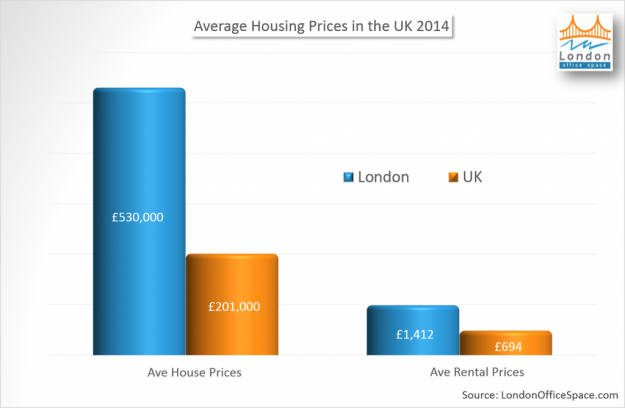
Compared to the rest of the UK, London has seen significant rises in house prices since the beginning of the recession. With the average home in the capital costing a painful £530,000 in 2014, many employees living in London are finding the property market is difficult to manage. Such steep rises are also reflected in rental prices, leading to a growing number of city workers commuting from outside areas, or living with their colleagues.

Housing for London Employees from LondonOfficeSpace.com

The Rising Cost of Housing in London

Between the start of 2014 and May 2014, housing prices in London rose by more than £87,000. The Bank of England’s governor, Mark Carney, has stated that there are deep structural problems within the city’s housing market, and that an absence of new builds may exacerbate the issue. Continue reading “Housing for London Employees”

Commercial Property Value in the UK Weakened in February

The performance of commercial property in the UK weakened this February according to CBRE’s latest Monthly Index. Total returns for commercial property in the UK fell to 0.1% and capital values fell by 0.4%. The downturn in commercial property performance came in spite of the fact that Central London offices have seen an improvement, with returns up from January, from 0.3% up to 0.5%. The weakening of property valuations covered the three main commercial property market sectors, shopping centres, shops and offices located outside of the Central London area.

On a more positive note, Central London offices have seen renewed growth, which is responsible for offsetting the decline of most parts of the commercial property market. Central London office property values saw an increase of 0.1% for the month.

According to the CBRE’s February 2012 UK Monthly Index survey total returns on all property were 0.1% for the month, with capital values down 0.4%. The retail property market suffered the most in February, providing a return of -0.1%, while industrial property returned 0.4% and offices returned 0.2% overall. Office property values for the rest of the country fell to 0.9% in February.

Rental values showed an improvement over the previous month while retail centres, shops and shopping centres suffered weaker returns, at -0.3%.The report went on to say that a third of commercial property investors have said that London is the most attractive property investment in the EU, ahead of Warsaw by more than 20%.

According to the CBRE’s Senior Analyst, Nick Parker, foreign investors are continuing to target and focus on the UK, and London in particular. Mr Parker said “this was because foreign investors are less constrained by a tight domestic debt market.” He also stated ‘Combine this finding with a healthy skew of respondents who said they intend to increase their overall purchasing activity in 2012 compared to last year, and the picture for the commercial property markets in London and the UK looks quite positive.”

References: Property Magazine and CBRE

Managing a vacant property

abandoned.jpg

What happens to a vacant property after the last tenants moved out and there are no signs of new occupants moving in? Managing vacant property may prove much tougher than it seems.

A recent survey carried out by SitexOrbis shows that the top three most important issues whilst managing vacant property are security, loss of rental income and empty property tax. Other key concerns included maintenance and compliance with insurance stipulations.

The recession has resulted in increased numbers of vacant commercial properties. The amount of available office accommodation in the city of London has gone up by 90 per cent between mid 2008 and mid 2009. Company and retail closures across Britain have repeated the same pattern in most major cities.

Many commercial property owners report a rise in squatting, vandalism, arson and break-ins; insurers are reporting an increase in large-scale fires. More than 50 per cent of landlords are unsure about the health and safety regulations for vacant properties.

The other concern is keeping properties in a fit condition for viewing and attracting new tenants. Landlords have to invest in protection solutions such as wireless alarms and other electronic security measures in order to tackle problems of squatters, criminal damage, arson and graffiti. Continue reading “Managing a vacant property”