New Developments in London Office Space: Central

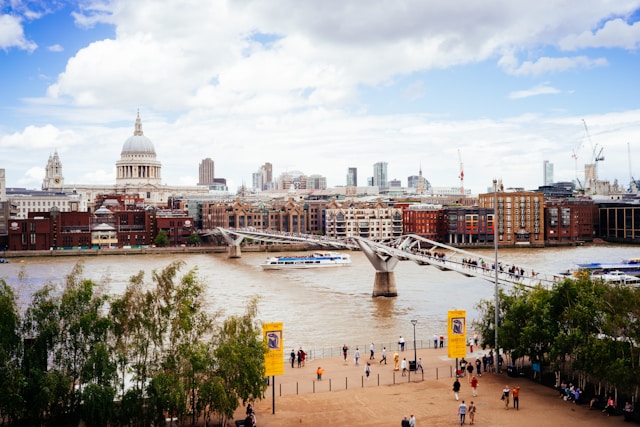
A daytime view down the bank of the River Thames towards the crowded Millennium Bridge and the central London cityscape beyond. Image at LondonOfficeSpace.com.

Knowing the status of the central London office development pipeline is essential for businesses looking to stay ahead in one of the world’s most dynamic real estate markets. By understanding the current trends and future developments, businesses can make informed decisions about their office space needs and take advantage of emerging opportunities.

In this article, we take a look into upcoming developments and what they mean for the Central London office leasing market. 

Central London offices development pipeline

According to data from the latest London Office Crane Survey, which looks in detail at the city’s development pipeline, the main highlight during the second half of 2023 was the record volume of square feet under construction. As of Q4 2023, there were more than 5 million square feet of new builds underway in central London, the highest amount since 2005. That figure represents a 16% increase over a six-month period. The report also identifies increases in project size, going from averages of 88,000 square feet in early 2023 to 119,000 square feet of properties in late 2023.

Continue reading “New Developments in London Office Space: Central”

How to Upgrade Your Office Space in Central London

A ground-up daytime view up the side of a shiny, glass-fronted skyscraper towards a cloud-strewn sky. Image at LondonOfficeSpace.com.

Central London is known for its dynamic commercial real estate market, which means local businesses must constantly adapt to new trends and requirements. Since 2020, the most significant trends in the London office space market have been downsizing and upgrading. 

In this article, we discuss when and how to consider upgrading to a larger or more prestigious office in central London, looking at the key signs that suggest you need an upgrade, and offering insights on how to navigate the process effectively. 

Two ways of upgrading office space

There are two primary ways to approach office space upgrades in central London: 

  • Moving to a larger office, which allows businesses to accommodate growth and improve employee satisfaction with new amenities and better facilities.
  • Relocating to better-equipped, modern office spaces, or a more prestigious address, which elevates the company’s image, enhancing credibility and attracting top talent and clients.

Continue reading “How to Upgrade Your Office Space in Central London”

Navigating Central London Office Market Trends

A daytime view along London’s Millennium Bridge towards St Paul’s Cathedral. People are walking on the bridge wearing dark winter clothes, and the cathedral’s dome rises in the distance above buildings on either side. Image at LondonOfficeSpace.com.

Being one of the world’s top business hubs, Central London offers a diverse array of office spaces tailored to the needs of modern businesses. Having said that, the city’s office market is constantly being shaped by various economic and demographic trends. In this article, we explore the current trends and factors shaping the office space market in Central London.

Demand for Office Space

Demand levels in the Central London office market have exceeded forecasts, reaching new record highs in early 2024 relative to the past 10 years. Data from early 2024 shows appetite for Grade A offices accounting for 70% of total transaction volume in Central London.

Occupier demand for quality space is evident in the disparity between vacancy rates for different office asset classes. For example, while in the City vacancy rates average 9.5% for all classes, new build vacancies are significantly lower at just 1.4%. Moreover and further confirming the strong demand for new offices, pre-let rates are high for new Class A office buildings, especially among financial services occupiers, as many developments are fully let by the time they’re released into the market.

Continue reading “Navigating Central London Office Market Trends”

Prime Locations for Office Space, Central London

A dusk view of St Paul’s Cathedral from the middle of Millennium Bridge. Image at LondonOfficeSpace.com.

Selecting an office space in a prime Central London location is a strategic choice that can add value to a company’s image. In addition to offering practical benefits like easy access and enhanced networking, office space in a prime Central London location fosters credibility and demonstrates commitment to high professional standards.

In this article, we take a look at some of the most sought-after office locations in Central London and explore the unique features that make these locations stand out.

Continue reading “Prime Locations for Office Space, Central London”

The Best Postcodes in Central London for Your Office

Dusk view down the River Thames of the illuminated Tower Bridge spanning the river with a purple and blue cloud-strewn sky in the background and riverbanks lined with buildings with postcodes in Central London.

Following the widespread adoption of remote work during 2020 and 2021, the majority of industry sectors are returning or have already returned to the office.

During this period, employee expectations regarding the office environment have changed. For example, many companies now report that staff increasingly demand shorter commutes, dedicated collaboration and relaxation space within the office, and upgraded amenities.

As a result, many business owners are considering downsizing and/or relocating their offices so the new location meets the needs of existing staff and future hires.

Since location is a key consideration, let’s look at what the most desirable central London postcodes are for your office in 2023 and beyond.

Continue reading “The Best Postcodes in Central London for Your Office”

Focus on Business in the City of London

Focus on Business in the City of London from LondonOfficeSpace.comWithin the square mile that makes up the City of London, there are more than 14,000 businesses. Fortunately the city’s landscape reaches high, otherwise there wouldn’t be much more room for budding entrepreneurs.

Known worldwide for being a hub of financial activity, the City of London is home to some of the world’s biggest accountancy firms, banks, and investors. Amongst the financial moguls you’ll find the occasional law firm, tech ventures like Google, and telecommunications outfits like Three. Competition for rental space is fierce, and the City of London’s local government does expect businesses to commit to sustainable practice. Knowing a little more about this area in general can help you determine whether it’s the right place to invest.

The City of London’s Financial Sector

The City of London is also known as the “Square mile”, and when investors worldwide hear that phrase, they know people are referring to the UK’s financial hub. There, you will find traditional banks and insurance agencies, including international branches like the Bank of America and the Bank of Canada. Foreign exchange businesses also thrive in the City of London, with a turnover of around 0.73 trillion alone.

Sitting at the heart of all this financial activity is the London Stock Exchange, which has been in existence since 1801. Alongside the heavily regulated London Stock Exchange is the alternative investment market, which exists for those who do not have the usual connections for traditional investing. It’s less well regulated, but it does open the financial floor up to a broader range of investors.

Although the finance industry dominates the City of London’s business activities, you will find the odd non-financial venture. This includes Google, which is home to one of London’s most innovative offices with hundreds of employees. Finally, there’s Three, which is a relative newcomer to the telecommunications industry, but is one that continues to grow stronger on a daily basis. Continue reading “Focus on Business in the City of London”

Overview of London’s Commercial Property Market — 3rd Quarter 2014

Overview of London's Commercial Property Market - 3rd Quarter 2014 from LondonOfficeSpace.comDuring the third quarter of 2014, the commercial property market in London has greatly benefited from a strengthened economy. Low interest rates and improved consumer confidence have contributed to making commercial floorspace in the British capital attractive to the eyes of investors and property managers, many of whom are trying to make the most out of the fact that overall prices still remain well below the peak they reached in 2007. During the past three months, average values for commercial property in London have been 31 per cent lower than in 2007. Return rates on investment for all types of commercial property have hovered around the 15 per cent mark, a slightly higher figure than the one experienced during the first half of the year. The commercial property market in London remains largely dominated by overseas investors, who currently have a 57 per cent market share, followed by UK institutions and property firms. Read on for more details on the market’s performance during the third quarter of 2014.

The London Office Market Q3 2014

On the whole, the cost of office space in central London is currently 4 per cent below its 2007 record high values. Having said that, it is important to note that some areas within central London have managed to return to or even exceed their pre-recession values. This is the case of offices in the West End, whose value increased by 5 per cent during the third quarter of this year. At the end of August 2014, office take-up rates in London were 17 per cent higher than during the previous year.

The latest data also show that the gap in prices between primary and secondary office stock in the city has been consistently narrowing down over the past quarter. Moderate rental growth is now evident across most city locations. However moderate, rental value increases and rising occupation costs have led more than 40 corporate occupiers to relocate from West End core offices to cheaper properties in areas like Midtown, the South Bank, or the city fringe. Year-on-year rental growth values are now 9.8 per cent higher in Midtown properties (which have been clearly outperforming those in other areas) and 7.3 per cent higher in city fringe locations.

Another trend worth mentioning is the significant number of central London offices that have been earmarked for conversion into residential properties. In the West End alone, more than 800,000 square feet of office space are set to be re-developed into residential floorspace within the next few years. It is expected that this trend will continue, as during the past three months consent has been granted to dozens of planning applications that will result in office-to-residential conversions. Continue reading “Overview of London’s Commercial Property Market — 3rd Quarter 2014”

The City of London’s Financial Giants

The City, London’s financial district, is been home to some of the worlds most prominent financial, trading, insurance, legal and religious institutions and is a part of London that, apart from the architecture, has remained almost intact since the Romans settled in 47 A.D. The Square Mile – which actually measures 1.12 square miles, has a modest resident population of around eleven thousand, although its transient working population swells to well over 330,000 every day.

The overall Gross Value Added (GVA) for London represents around 45% of the overall sector at some £52 billion and the sector as a whole contributed tax revenues of £53.4bn.
Of the total employed in the City, 42% or 135,000 are employed in the financial sector (from cityoflondon.gov.uk 2009).

Classed as one of three key financial centres around the world, London plays host to many of the leading banks as well as the Stock Exchange and whilst The City is home to some, the influential banking and financial institutions have also spread into the Canary Wharf area. Only four of the top five UK banks are based in the City the other is in Edinburgh (RBS).

The top four London banks are: HSBC (Canary Wharf), Lloyds (City), Barclays (Canary Wharf) and Standard Chartered (City). Between them these four have market values of ~£240 bn. and assets of ~£5,500 bn.

Their employment numbers are substantial, however it is difficult to obtain exact numbers of how many are employed specifically within the 135,000 in the City of London. For that reason we look at the whole of the UK; HSBC alone has 85,000 employees in the UK, spread around its major brank and city centre network. Lloyds, in which the British Government holds a minority stake, indicates that it employs in excess of 104,000 (2010 figures). Barclays employs 146,000 (as at 2011) and Standard Chartered, 84,000.

Looking at Operating Income and stated gross margins for 2010, each is a substantial business:
HSBC – £12 bn. profit £8.3 bn.
Lloyds – £281 m, (£258 m)
Barclays – £3 bn. (profit not stated)
Standard Chartered – £3.85 bn. (profit not stated)

What is clear is that the banking sector within the UK, let alone the world has gone through an upheaval that is unprecedented and it may take some time to settle into a stable sector again. The British Government is under increasing pressure to return Lloyds to the private sector once more and is looking at many options including the restructuring of the bank into two separate – corporate and personal banking streams. Given their relative financial strength, HSBC, Barclays and Standard Chartered have demonstrated their ability to weather the financial maelstrom despite calls within Government to review and deconstruct the so called bonus culture.

Alongside the major banks, the city is home to the main regulatory body of The Bank of England, an institution to whom the key players look for guidance. It sets the level of interest (Bank Base Rate), currently at 0.5% (for a record three-years), and manages and monitors inflation by intervention in specific sectors as and when required. It is also responsible for the total amount of money flowing through the UK economy and regularly reviews this.

Lloyds, the insurance house, is also established in The City, and home to around fifty of the world’s largest insurance businesses with access to assets in excess of £40,000 bn. to support its infrastructure of risk underwriting and provides cover for every sector of business around the Globe. In excess of 20% of its revenue is derived in the UK.

Finally, the London Stock Exchange – often abbreviated to LSE, is one of the half dozen trading platforms around the world that are seen as the metre by which investors judge the health of commerce. It hosts a number of UK based indices – e.g. the FTSE 100, whereby the value of a business is posted daily in terms of its share price and capitalisation. In sheer scale, the level of activity is huge and in 2010 its market capitalisation was claimed to be £2.27 trillion spread across some 3,000 individual business listings.